When people think of engagement rings, they often think of diamonds. There are several reasons why diamonds are one of the most popular engagement gemstones — their brilliance and durability being two of the most common. Yet, despite their popularity, diamonds aren’t the only option for those wanting to invest in a quality stone.
With a look very similar to that of a diamond, moissanite is a popular alternative — it is, in fact, one of the most common engagement ring gemstones after diamonds. In this blog, we’ll delve into the ins and outs of moissanite vs. diamond rings, looking at factors such as price, durability, brilliance and colour, as well as some practical tips on choosing a moissanite ring. Let’s dive in.
What is moissanite?
Moissanite is a rare, natural mineral called silicon carbide, named after Henri Moissan, who first discovered it in a meteor crater in Arizona, USA, in 1893. Moissanite is so rare that it can’t be found naturally in sizes large enough to cut into one-carat stones — for this reason, the moissanite used in fine jewellery today is laboratory-created. This is in contrast to diamonds, which are derived naturally.
Known as a diamond simulant, moissanite is engineered to look similar to diamonds. Still, the two are visually and compositionally different in terms of colour, brilliance and durability — however, both forms are good thermal conductors. Yet despite their differences in origin and composition, Moissanite and diamonds share several similarities.
Moissanite vs. diamonds — what to consider
Price
Moissanite and diamonds vary significantly in price — many consider this one of moissanite's biggest advantages. A moissanite gem is approximately one-tenth the price of a natural diamond of equal size.
While diamonds are priced according to a range of factors, including carat, clarity, colour, cut and shape, the price of moissanite generally varies according to the size and quality of the stone. Moissanite is a viable alternative for people wanting a large-carat, quality white gemstone but without the budget required for a massive diamond.
Brilliance
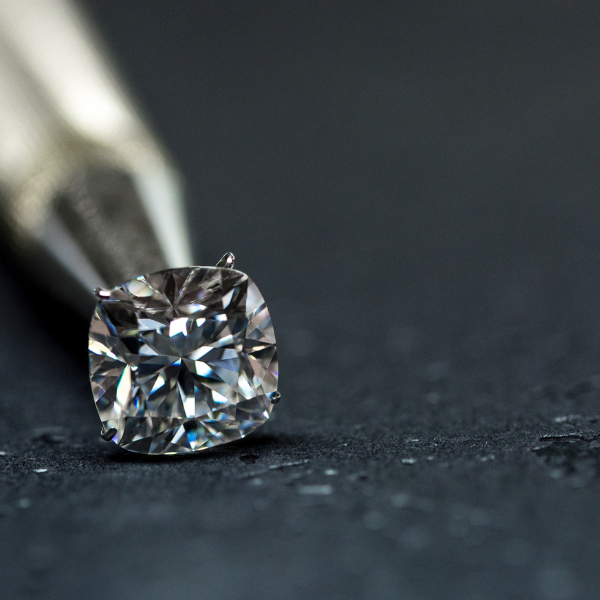
When it comes to gemstones, brilliance is the amount of light reflected from the interior of the stone. Moissanite is generally considered to exhibit more brilliance than a diamond — the bigger the moissanite, the more noticeable the difference. It is also a different kind of brilliance to that of a diamond.
While a diamond reflects a whiter light, moissanite exhibits a rainbow-like effect of colours due to its higher dispersion value and refractive index, which enhances the sparkle. With brilliance, it is often a matter of preference — some prefer the fiery, rainbow brilliance of moissanite, whereas others prefer the whiter light reflected by diamonds.
Colour
Both moissanite and diamonds can be colourless or have a trace of colour. Moissanite traditionally carries a yellow, grey or green hue, but thanks to modern creation processes, high-quality colourless moissanite is now available. However, as with brilliance, the bigger the moissanite, the more noticeable any colour.
Diamond colour can vary significantly and is graded on a scale of D to Z, with D being colourless and therefore projecting a bright, dazzling white appearance, and Z being a light brown or yellow colour. Colours beyond Z are considered fancy coloured diamonds and include strong shades of brown, yellow, purple, red, pink, green and blue.
Durability
In terms of durability, gemstones are measured according to the Mohs Scale of Hardness — this assesses their ability to cope with surface scratching. Diamonds score a ten on the scale, making them the hardest known naturally occurring mineral. Because of this, diamonds are considered extremely durable and able to withstand just about any kind of wear and tear. Though not completely unbreakable, they are ideal for everyday wear.
Moissanite is a 9.25 to 9.5 on the scale, making it the second hardest gemstone next to diamonds. Although not quite as tough as diamonds, they are still suitable for everyday wear.
Origin
As moissanite is created in a laboratory, it can be an appealing option for those wanting a gemstone that requires no mining. However, responsible jewellers are committed to ethically sourcing materials and gemstones. At Diamonds Factory, we take special care to ensure our materials and gems are both of the highest quality and ethically sourced.
The benefits of investing in moissanite
Both moissanite and diamonds are popular engagement ring gemstones. Those looking for an alternative to traditional diamond rings appreciate the benefits that moissanite has to offer:
Value
Moissanite is considerably less expensive per carat than diamonds.
Durability
Moissanite is slightly less durable than diamonds, making them suitable for daily wear.
Mining free
Being lab-created, moissanite has minimal environmental impact, so there’s no need to compromise your values to find the perfect stone.
Moissanite vs diamonds — which is better?

Ultimately, the question of which gemstone is better comes down to personal preference. We recommend that you choose whichever stone feels right for you. While some love the fiery, rainbow effect of moissanite’s brilliance, others find this too much and prefer the classic, romantic appeal of diamonds. Some also prefer the assurance of hardness that comes with diamonds.
For those looking for a viable alternative to the classic diamond, it can be worth noting that moissanite is the only gem that will pass as a diamond on a handheld diamond point test. So, moissanite is a great option for anyone wanting a gemstone that resembles a diamond without the high price tag.
Again, it all comes down to personal preference and taste — we recommend that you take the information in this article and use it to make the best decision for you!
Choosing a moissanite
Although shopping for moissanite is similar to shopping for any type of gem, there are a few factors to consider when choosing one. Firstly, don’t feel you need to settle on a lower-quality stone due to budget restrictions. It is more than possible to find high-quality moissanite at a reasonable price.
To help determine if moissanite is of high quality, look for a good polish with very few surface scratches and a bright lustre. While diamonds are graded on carat, clarity, colour and cut, moissanite is graded only on its colour — cut and clarity grades are similar across these gemstones.
Importantly, moissanite looks good in just about any ring setting and pairs exceptionally well with diamonds and other gemstone accents. With the help of a reputable and trusted jeweller (like us), finding a high-quality moissanite piece that you love should be relatively simple!
Diamonds Factory — your trusted supplier of exceptional quality jewellery
We hope this post has helped answer some of your questions on moissanite vs. diamonds. At Diamonds Factory, we’re committed to providing exceptional quality jewellery at the lowest possible prices. All of our jewellery is handcrafted by our in-house team of expert artisans, and special care is taken to select ethically sourced materials of the highest quality.
By cutting out the middleman and designing, crafting and delivering your piece directly to you, we can offer unbeatable value on our entire range, including diamond and moissanite rings, and our convenient ready-to-ship range. What’s more, our jewellery experts are always on hand and happy to help you find your dream jewel. View our entire collection online today, or get in touch with our team about designing your dream ring!







 Unlock private sale access
 Birthday privileges
 Plus a world of exclusives, curated for you.


When people think of engagement rings, they often think of diamonds. There are several reasons why diamonds are one of the most popular engagement gemstones — their brilliance and durability being two of the most common. Yet, despite their popularity, diamonds aren’t the only option for those wanting to invest in a quality stone.
With a look very similar to that of a diamond, moissanite is a popular alternative — it is, in fact, one of the most common engagement ring gemstones after diamonds. In this blog, we’ll delve into the ins and outs of moissanite vs. diamond rings, looking at factors such as price, durability, brilliance and colour, as well as some practical tips on choosing a moissanite ring. Let’s dive in.
What is moissanite?
Moissanite is a rare, natural mineral called silicon carbide, named after Henri Moissan, who first discovered it in a meteor crater in Arizona, USA, in 1893. Moissanite is so rare that it can’t be found naturally in sizes large enough to cut into one-carat stones — for this reason, the moissanite used in fine jewellery today is laboratory-created. This is in contrast to diamonds, which are derived naturally.
Known as a diamond simulant, moissanite is engineered to look similar to diamonds. Still, the two are visually and compositionally different in terms of colour, brilliance and durability — however, both forms are good thermal conductors. Yet despite their differences in origin and composition, Moissanite and diamonds share several similarities.
Moissanite vs. diamonds — what to consider
Price
Moissanite and diamonds vary significantly in price — many consider this one of moissanite's biggest advantages. A moissanite gem is approximately one-tenth the price of a natural diamond of equal size. While diamonds are priced according to a range of factors, including carat, clarity, colour, cut and shape, the price of moissanite generally varies according to the size and quality of the stone. Moissanite is a viable alternative for people wanting a large-carat, quality white gemstone but without the budget required for a massive diamond.
Brilliance
When it comes to gemstones, brilliance is the amount of light reflected from the interior of the stone. Moissanite is generally considered to exhibit more brilliance than a diamond — the bigger the moissanite, the more noticeable the difference. It is also a different kind of brilliance to that of a diamond. While a diamond reflects a whiter light, moissanite exhibits a rainbow-like effect of colours due to its higher dispersion value and refractive index, which enhances the sparkle. With brilliance, it is often a matter of preference — some prefer the fiery, rainbow brilliance of moissanite, whereas others prefer the whiter light reflected by diamonds.
Colour
Both moissanite and diamonds can be colourless or have a trace of colour. Moissanite traditionally carries a yellow, grey or green hue, but thanks to modern creation processes, high-quality colourless moissanite is now available. However, as with brilliance, the bigger the moissanite, the more noticeable any colour. Diamond colour can vary significantly and is graded on a scale of D to Z, with D being colourless and therefore projecting a bright, dazzling white appearance, and Z being a light brown or yellow colour. Colours beyond Z are considered fancy coloured diamonds and include strong shades of brown, yellow, purple, red, pink, green and blue.
Durability
In terms of durability, gemstones are measured according to the Mohs Scale of Hardness — this assesses their ability to cope with surface scratching. Diamonds score a ten on the scale, making them the hardest known naturally occurring mineral. Because of this, diamonds are considered extremely durable and able to withstand just about any kind of wear and tear. Though not completely unbreakable, they are ideal for everyday wear. Moissanite is a 9.25 to 9.5 on the scale, making it the second hardest gemstone next to diamonds. Although not quite as tough as diamonds, they are still suitable for everyday wear.
Origin
As moissanite is created in a laboratory, it can be an appealing option for those wanting a gemstone that requires no mining. However, responsible jewellers are committed to ethically sourcing materials and gemstones. At Diamonds Factory, we take special care to ensure our materials and gems are both of the highest quality and ethically sourced.
The benefits of investing in moissanite
Both moissanite and diamonds are popular engagement ring gemstones. Those looking for an alternative to traditional diamond rings appreciate the benefits that moissanite has to offer:
Value
Moissanite is considerably less expensive per carat than diamonds.
Durability
Moissanite is slightly less durable than diamonds, making them suitable for daily wear.
Mining free
Being lab-created, moissanite has minimal environmental impact, so there’s no need to compromise your values to find the perfect stone.
Moissanite vs diamonds — which is better?
Ultimately, the question of which gemstone is better comes down to personal preference. We recommend that you choose whichever stone feels right for you. While some love the fiery, rainbow effect of moissanite’s brilliance, others find this too much and prefer the classic, romantic appeal of diamonds. Some also prefer the assurance of hardness that comes with diamonds.
For those looking for a viable alternative to the classic diamond, it can be worth noting that moissanite is the only gem that will pass as a diamond on a handheld diamond point test. So, moissanite is a great option for anyone wanting a gemstone that resembles a diamond without the high price tag.
Again, it all comes down to personal preference and taste — we recommend that you take the information in this article and use it to make the best decision for you!
Choosing a moissanite
Although shopping for moissanite is similar to shopping for any type of gem, there are a few factors to consider when choosing one. Firstly, don’t feel you need to settle on a lower-quality stone due to budget restrictions. It is more than possible to find high-quality moissanite at a reasonable price.
To help determine if moissanite is of high quality, look for a good polish with very few surface scratches and a bright lustre. While diamonds are graded on carat, clarity, colour and cut, moissanite is graded only on its colour — cut and clarity grades are similar across these gemstones.
Importantly, moissanite looks good in just about any ring setting and pairs exceptionally well with diamonds and other gemstone accents. With the help of a reputable and trusted jeweller (like us), finding a high-quality moissanite piece that you love should be relatively simple!
Diamonds Factory — your trusted supplier of exceptional quality jewellery
We hope this post has helped answer some of your questions on moissanite vs. diamonds. At Diamonds Factory, we’re committed to providing exceptional quality jewellery at the lowest possible prices. All of our jewellery is handcrafted by our in-house team of expert artisans, and special care is taken to select ethically sourced materials of the highest quality.
By cutting out the middleman and designing, crafting and delivering your piece directly to you, we can offer unbeatable value on our entire range, including diamond and moissanite rings, and our convenient ready-to-ship range. What’s more, our jewellery experts are always on hand and happy to help you find your dream jewel. View our entire collection online today, or get in touch with our team about designing your dream ring!